
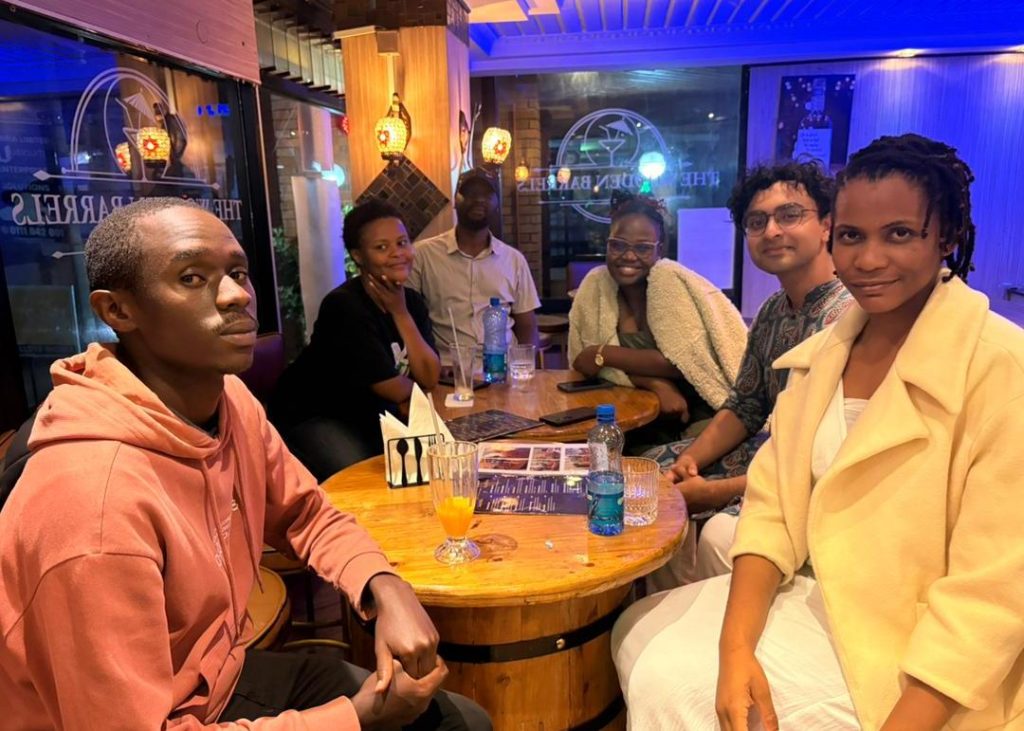
EAAK has held three Revolutionary Nights in Nairobi, one each month. We have found them useful for building relationships, exchanging ideas and connecting people interested in effective altruism and animal advocacy. However, we do not yet have enough evidence to claim that these events have produced substantial downstream impact for animals. This article therefore presents our current theory of change, early observations and hypotheses about how community-building might contribute to more effective animal advocacy in Kenya.
Over the past three months, Effective Animal Advocacy Kenya (EAAK) has brought Nairobi’s effective altruism and animal advocacy communities together for three Revolutionary Nights once per month.
The idea behind Revolutionary Nights is simple but powerful: when people with shared values come together, they can exchange knowledge, build relationships and increase their collective capacity to solve important problems.
Inspired by the broader global Revolutionary Nights movement, these gatherings create an informal space where advocates, researchers, volunteers, students and people curious about social impact can connect beyond the usual meetings and conferences. Participants share ideas, discuss pressing challenges, discover opportunities to collaborate and, importantly, get to know the people working alongside them.
For EAAK, the nights have become more than just social gatherings. They are a way of strengthening the local movement, one conversation, one connection and one collaboration at a time.
Can recurring community-building create additional capacity for effective animal advocacy in Kenya?
After three events, we have some early reasons to think the answer could be yes. We have seen opportunities for people to connect, learn about animal advocacy, exchange ideas and identify areas of shared interest. But we also recognize that these are intermediate outcomes. The ultimate question is whether these connections translate into people taking useful actions, developing collaborations, contributing skills and ultimately improving outcomes for animals.
Why bring people together?
Farm animal advocacy is a large-scale problem with limited resources.
Billions of farmed animals are raised and killed every year, while animal welfare receives relatively little philanthropic attention compared with the scale of the problem. Within effective altruism, this has led to animal welfare being considered through concepts such as scale, neglectedness and tractability.
But funding is not the only constraint.
Animal advocacy also needs people with the right skills, knowledge and networks. We need researchers, veterinarians, campaigners, communicators, fundraisers, policy specialists, farmers, entrepreneurs, students and many others.
This raises a question for EAAK:
Could bringing the right people together increase the capacity of the animal advocacy movement in Kenya?
This is the basic hypothesis behind our Revolutionary Nights.
What are Revolutionary Nights?
Revolutionist Nights are informal gatherings where people interested in effective altruism, social impact, animal advocacy and other important problems can meet, exchange ideas and build relationships.
Rather than functioning like a formal conference, Revolutionary Nights create a relaxed and informal environment where meaningful conversations can happen naturally—conversations that may not take place in traditional professional settings.
Someone might attend because they already work in animal advocacy. Another person may come because they are interested in Effective Altruism. Someone else might simply be curious about global challenges and wondering how they can contribute to solving them.
There is no single type of person the events are designed for. That openness is intentional.
We believe that bringing more people into conversations about animal welfare, effective giving, and social impact can create connections and opportunities that are difficult to predict in advance. A casual conversation can lead to a new collaboration, a volunteer opportunity, a new career path, or simply inspire someone to become more involved.
In this sense, Revolutionary Nights are not just social gatherings—they are spaces for building the relationships, ideas, and networks that can strengthen the animal advocacy movement
Three Revolutionary Nights in Nairobi: What We Are Learning
Over the past three months, Effective Animal Advocacy Kenya (EAAK) has held three Revolutionary Nights in Nairobi, one each month. These gatherings bring together people interested in effective altruism, animal advocacy, social impact and creating positive change.
Our most recent Revolutionary Night was held on 14 August at Wooden Barrel in Nairobi. We are grateful to everyone who attended, shared ideas and contributed to the conversations. We also appreciate those who were unable to attend but took the time to send their apologies.
Rather than measuring success only by attendance, we are interested in a bigger question:
What happens because people meet?
Why Revolutionary Nights?
Our main idea is that bringing people together can strengthen the animal advocacy movement.
The pathway we are exploring is:
Meeting people → sharing knowledge → building relationships → creating collaborations → increasing advocacy capacity → developing better interventions → improving outcomes for animals.
Of course, this is a hypothesis, not something we can yet prove.
Attending an event does not automatically mean someone will become an advocate or start a project. That is why we are interested in what happens after each Revolutionary Night.
A conversation could lead to a volunteer joining EAAK. Someone could introduce us to a potential partner. A researcher could identify an important gap in animal-welfare knowledge. A participant with communication or veterinary skills could find a way to contribute.
Even one valuable connection could potentially lead to much more work in the future.
Why does this matter in Kenya?
Animal advocacy requires more than funding. It also needs people with different skills, knowledge and experience.
Kenya has its own agricultural systems, food markets, institutions and animal-welfare challenges. Solutions that work in other countries may not always work in the same way here.
Revolutionary Nights allow us to discuss questions such as:
- Which animal-welfare problems are most important in Kenya?
- Which problems are neglected?
- Which solutions are realistic?
- What evidence do we already have?
- What research is still needed?
- Where can EAAK have the greatest contribution?
These conversations help us think beyond simply identifying problems and toward finding effective practical solutions.
Building relationships and partnerships
One of the biggest benefits we see from Revolutionary Nights is the opportunity to build relationships.
People from different backgrounds can meet and discover shared interests. Animal advocates can connect with researchers, veterinarians, students, communications professionals, entrepreneurs and others interested in social impact.
These relationships can become the foundation for future collaborations.
For EAAK, this is particularly important as we continue building the capacity of animal advocacy in Kenya.
What have we learned?
After three monthly events, we believe Revolutionary Nights are promising, but we also recognize that we need to keep learning.
We do not want community-building to become an end in itself. A large network does not automatically mean greater impact.
Going forward, we want to pay more attention to outcomes such as new volunteers, collaborations, partnerships, research projects, skills contributed and people becoming more engaged in animal advocacy.
This will help us understand whether the time and resources invested in these gatherings are producing meaningful results.
Looking ahead
Our three Revolutionary Nights have shown us the value of creating spaces where people can meet, think together and explore ways to contribute.
We hope to continue building on this momentum while experimenting with different formats and topics.
For EAAK, Revolutionary Nights are more than social gatherings. They are an opportunity to build the relationships, knowledge and networks needed for a stronger animal advocacy movement in Kenya.
We do not yet know exactly how much impact these events will create. But we believe the best way to find out is to keep experimenting, measure what happens and learn from the results.
One conversation can become a connection.
One connection can become a collaboration.
And one collaboration can become action for animals.
Leave a Reply